Friday, 20 April 2018

Ritsurin Garden and Zentsū-ji

Ritsurin Garden Map
Ritsurin Garden is one of the most famous gardens in all of Japan. It is historical and existed as a private garden to the fuedal lord who created it in 1625. The first section to be built was the south pond area and the garden was expanded by various owners since until it became a prefectural garden and opened to the public.
Ritsurin Garden
The garden is an intricate maze of pathways through various manicured areas. The area on the left side of the map is mostly coniferous trees around the ponds with some sections of Japanese Maple. Small bridges link pathways and create a very intricate walkway system and add to the scenery.
Ritsurin Garden
Ritsurin Garden
Ritsurin Garden
  Wildlife is common in the gardens despite being in the middle of a city. SOme areas are blocked to fish and tadpoles are thriving in large numbers (and of massive size as well). A few species of turles were observed including Chinese Softshell Turtle, Red-eared Sliders and some nondescript turtle that I didn't get a good enough look at to identify.
Tadpole
Chinese Softshell Turtle (Pelodiscus sinensis)
A waterfall in the back of the garden with the forested hill in the background makes it quite obvious what attracted the feudal lords to this specific site in the city to create a beautiful garden.

Ritsurin Garden
Although the manicured scenery has a very Japanese style beauty, there are not a lot of herbaceous plants in the garden and very few 'pretty flowers' to look at. Scattered around the mowed grass were some 'weeds' that managed to survive the cutting. 
Blue Toadflax (Nuttallanthus canadensis)
 Some flowering trees, including the cherry blossoms, had finished blooming but scattered around the deciduous part of the garden were some Dogwood (Cornus) flowering. Otherwise it was mostly Rhododendron shrubs adding a bit of colour to the garden.

Ritsurin Garden

Ritsurin Garden
The deciduous side of the garden is less open and much greener. It still lacks a healthy understory of vegetation but it has a much higher diversity of trees.
Ritsurin Garden
Japanese Maple has always been a favorite of mine. I love how they grow a bit twisty and how pretty they are when they change colour in the fall. I never noticed before how cute their flowers were though.
Japanese Maple Flowering
After the garden we went to visit a temple (Zentsū-ji). Again we got there at sundown and all of my photos are in the dark. The pagoda at least is lit up at night. The temple is quite old and covers a large area. The grounds are dirt everywhere with no lawn and only a small forested area with some understory. The trees here are quite old and impressive. The wood  on the bu8ildings is intricately carved but still simple as to be not eclectic.
Zentsū-ji

Zentsū-ji

Kazurabashi of Iya

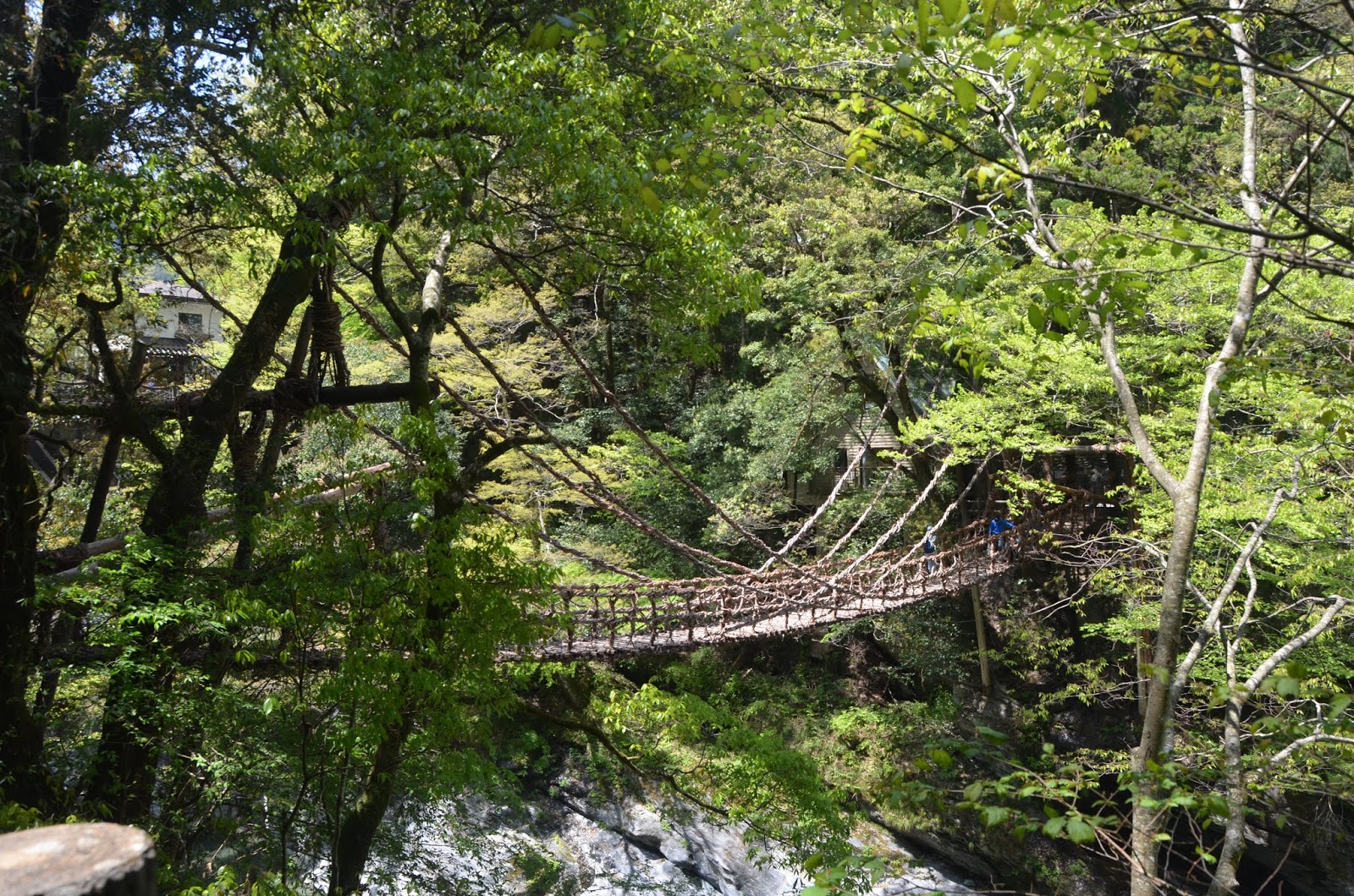
The Kazurabashi of Iya or the Vine Bridge in Iya Valley is a bit of an overstated tourist attraction. It is a small walking bridge that you pay to cross. They even built a pedestrian bridge on the side of the road so you can view the bridge.
Kazurabashi of Iya
Kazurabashi of Iya
The Japanese Wisteria (purple vine in the photos) smells extremely fragrant and although it is very common throughout Shikoku it set the scene very nicely by blooming right in front of the bridge. It smells amazing and pollinators love it so you can almost here their buzz over the crowds of tourits.
Kazurabashi of Iya
I didn't pay to cross the bridge because the view is nicer looking at it but it was incredibly busy and is quite impossible to get a photo without anyone on the bridge. There was usually a line-up to cross and the best was when there was a bit of a lull in customers and I had only a few people or people in dull colours crossing.
Kazurabashi of Iya from behind

The waterfall nearby the bridge is really really close and is just right on the side of the road. It is a small but nice waterfall flowing into a small pool and down into the main river. A lot of ferns, moss and marchanita growing on the rocks with bright green Japanes maples making a nice canopy made the spot look intensely green.
Marchantia
Waterfall near Kazurabashi of Iya
There was a Japanese Brown Frog by the waterfall  that was a lovely treat to see and photograph.  There are a lot of frogs in the genus Rana that look quite similar to this in Japan so I hope my ID is correct on this one. I have been using a Japanese field guide and google translate only works so well with it.
Japanese Brown Frog (Rana japonica)

Thursday, 19 April 2018

Muronto Cape

The way to Muronto Cape is scenic when you get to the coastline. The closer you get to the cape the more you see scenic views of beaches and rocky areas but these are spaced out with seawalls and breakers, which I admit look quite stark and unappealing in contrast to the more natural areas.
Shrine along highway 55 towards Muronto Cape
Muronto Cape
The viewpoint at
Black-eared Kite viewed from lookout point at Muronto Cape

Muronto Cape
The lighthouse isn't much to talk about but it has closer up views of the cape.
Lighthouse at Muronto Cape
The Hotsumisaki Temple is just above the lighthouse. It is one of my favorites so far on Shikoku. It is set surrounded by an old wooded area with large trees. The temple buildings are simple but with intricate carvings. As part of the pilgrimage, the Hotsumisaki Temple has places to stay overnight.

The temple is also home to a lot of wildlife and I was able to see birds and a skink on the temple grounds.
Hotsumisaki Temple

Hotsumisaki Temple

Hotsumisaki Temple
Skink at Hotsumisaki Temple

William very much enjoyed the chance to ring a big bell that echoed though the hills. It sounds lovely and is the exact sound I pictured hearing at the temple.
Hotsumisaki Temple
The coastline is rocky with large formations and an area of thicket vegetation occurring as the area sloped up inland. The vegetation was quite interesting with some recognizable genera and some species that I have never seen before.

There are some trails going along the coast weaving though the thicket vegetation and giving some nice views of the ocean and the rocks. We didn't have to much time so we only did a short loop. It was very very calm the day we went to the cape but I hear that the ocean can be quite fierce at the cape.  I very highly recommend visiting this scenic area and taking the time to visit all of it.

Muronto Cape

Muronto Cape
Japanese Pittosporum (Pittosporum tobira)
Sea Fig (Ficus superba)

Monkey at Muronto Cape
On the way home a detour took us up to a temple in the mountains. The road is winding and you park below the temple and hike up to the temple. The small hike up was nice but we didn't get to the temple until after dark. The temple was very very old and the rocks and statues at the temple had large lichens all over them.

Gate up to temple

Sunday, 15 April 2018

Walk to the Seashore Along the Monobe River

A walk to where the Monobe River meets the shoreline of the Pacific Ocean at 吉川展望台 is 15 km from the Kochi University of Technology one way. It has nice scenery of the Monobe River along a path/roads going along the river.
Monobe River, Kochi, Japan

Monobe River, Kochi, Japan
 Most of the area is farm fields with some areas for housing. At this time of year they have just been planting the rice and if it wasn't so windy they would have had a nice reflective surface on them with only small sprigs of the grass growing up.
Rice fields in Kochi, Japan
Along the path we found a red-headed centipede. This one was about a foot long! Watching them move is pretty cool and luckily it never felt bothered by us watching it so it didn't move very fast at all. Apparently they have a pretty nasty bite.
 We stopped at an eel restaurant along the way for lunch. Eel pretty much just tastes like fish but they cook it very nicely with some sort of sauce. It is a bit of a delicacy and was more expensive than most restaurants in Japan but still very very reasonable compared to Canada.
Eel restaurant, Kochi, Japan
Small portion of eel
Inside eel restaurant, Kochi, Japan
Closer to the shoreline in the tsunami inundation zone there are large concrete structures every subdivision or so. They almost look like a parking structure but just have a series of ramps going up to the top of a concrete platform.
Tsunami structure, Kochi, Japan
 There is a lookout where the Monobe meets the ocean and the view is quite nice. 
Monobe River, Kochi, Japan

Monobe River, Kochi, Japan
 A fair number of birds were hanging out along the rivers end. Most fascinating was a group of Eastern Buzzards fishing in the river. The water was very high and fish appeared to be collecting in an area where the water was pooling and moving slower.
Eastern Buzzard
Eastern Buzzard
The walk back to campus took a while but it was very beautiful with a gorgeous sunset over the river and the mountains.
Monobe River, Kochi, Japan

Wednesday, 11 April 2018

Nishijima Horticultural Park

Nishijima Horticultural Park
 Today we did a trip to Nishijima Horticultural Park, a farm/ nursery, for strawberry picking. You can go strawberry picking for Y1150. You go picking in a greenhouse for an unlimited amount of time and they give you condensed milk for dipping. 
Strawberry Picking at Nishijima Horticultural Park

Strawberry Picking at Nishijima Horticultural Park
The main building is has tables and bougainvillea shrubs creating a hanging arch over tables. You can buy fresh food at a small sort of cafe and relax at the tables. You can also buy melons, watermelons, treats and potted plants. They even had some interesting carnivorous plants for sale.
 Nishijima Horticultural Park

 Nishijima Horticultural Park
 I bet these would be quite useful in our house. It will get quite buggy in the summer since it is already warming up and so many insects find their way into our house already.
Sundew
Sundew