Saturday, 20 April 2019

Herpin' Pensylvania for Easter - Colonel Denning State Park and Waggner's Gap

With the prospect of a cold dreary Easter my family decided to head down south where the weather was warmer and spring was more along the way. The weekend was full of promise and we had a loop planned to visit a whole lot of State Parks and National Forests in Pennsylvania.
Colonel Denning State Park
Our first stop was Colonel Denning State Park near Carlisle, PA. The deciduous oak forest was scattered with witch hazel and tulip trees.
Colonel Denning State Park

Colonel Denning State Park
The forest floor was littered with leaves and moss. One of the first critters I spotted was a Tiger Beetle hunting in the dead leaves.
Six-spot Tiger Beetle
The Appalachian area is really well know for its salamander diversity. Colonel Denning State Park is a great place for finding salamanders. Finding this very chunky Red Salamander was definitely a highlight of the trip and a lifer for me.
Red Salamander (Pseudotriton ruber)
 Eastern Redback Salamanders are common in eastern Canada and the United States. Their color is variable with a slate grey background with lighter flecks. Some have a red stripe on the back while others are a grey "Leadback" colour phase.
Eastern Redback Salamanders (Plethodon cinereus)
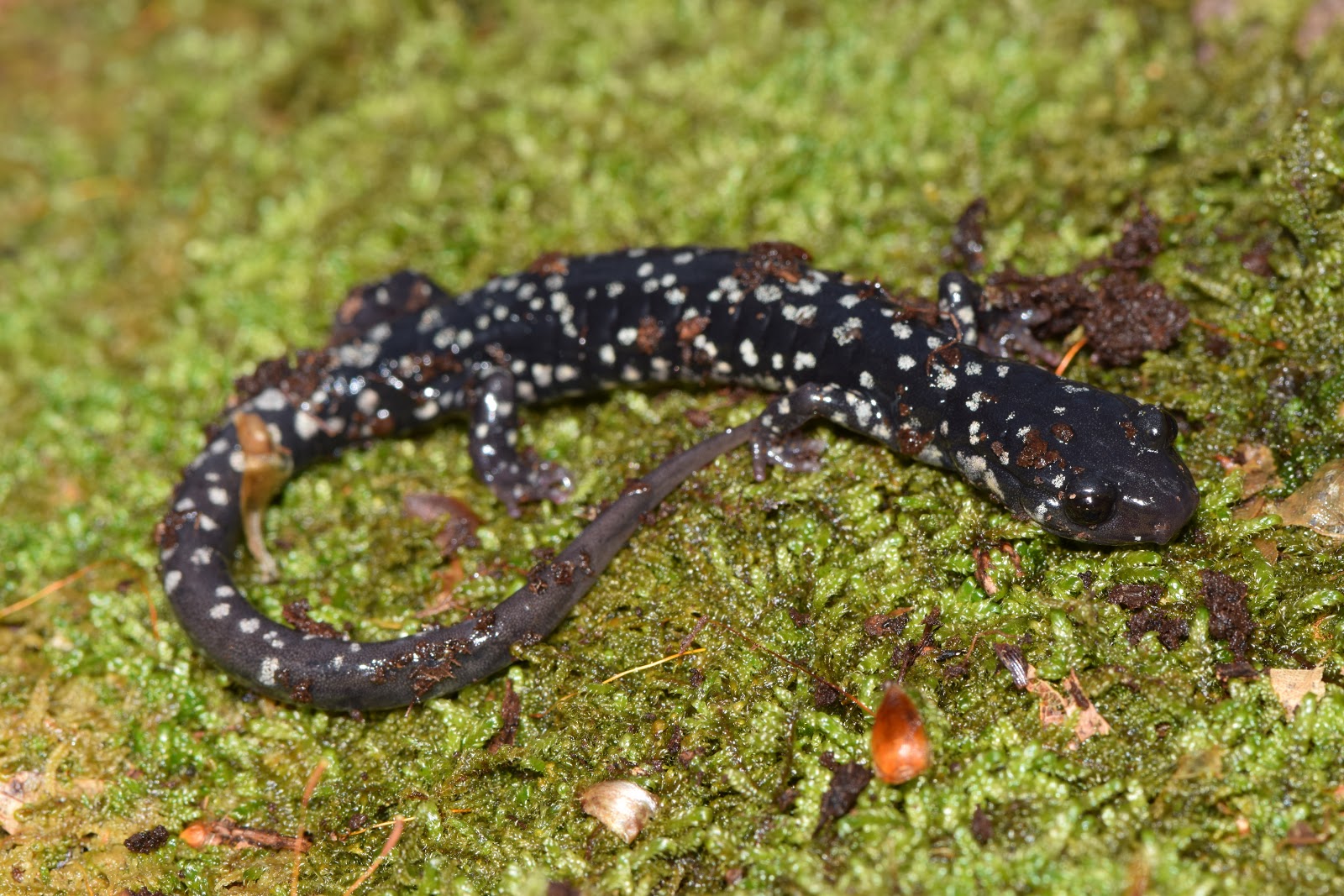
 Slimy Salamanders live in moist soil/ leaf litter in deciduous forests. This species isn't found in Ontario, but I have seen them before in southern Illinois. Like Redback Salamanders, this species doesn't use vernal pools to breed and the females will guard the clutch.
Northern Slimy Salamander (Plethodon glutinosus)
In Ontario spring flora hasn't really sprung but the trip down we had pleasant views of Eastern Redbud in full bloom along the edges of woodlots. The under-story 
White Violet (Viola blanda)
Hepaticas are early blooming species that vary from white to light purple in colour. The leaves and stems are hairy and evergreen with three lobes.
Round-leaved Hepatica (Anemone canadensis)
 Rue-anemone is a lovely spring flowering plant. The white flowers site atop a whorl of leaves with rounded teeth.
Rue-anemone (Thalictrum thalictroides)

Waggner's Gap is close to Colonel Denning State Park. It is a local birding hotspot and in particular a spot for viewing raptor migration. The forest was a mix of oak and cherry trees. The area was rockier than thh trail we had gone on in Colonel Denning State Park and it wasn't as good for salamanders.
Waggner's Gap
Waggner's Gap
Waggner's Gap

Friday, 12 April 2019

Vernal Pools and Amphibians in Ontario

This year I waited anxiously for the perfect weather, warm rainy nights that would spark an annual migration. Then I went to a few places I know of with vernal pools looking for breeding amphibians. Some years I have seen so many salamanders that your photos were bombed by multiple salamanders all heading down into the pools. This year the weather was a bit spotty but the salamanders did move in fairly large numbers. The night was rainy and cold but the tiny amphibians were moving to the ponds.
Suspected Jefferson-Blue Spotted Salamander Complex
When I arrived at the first pond the usual chorus of Spring Peepers and Wood Frogs wasn't quite in full force but they were calling.  Pickerel Frogs aren't rare in Ontario but they are uncommon finds in the areas I was looking in.
Pickerel Frog (Lithobates palustris)
 Pickerel Frogs look very similar to Northern Leopard Frogs but are identified by two rows of square spots along the back, bright yellow inner thighs and a lack of bright outlines to the spots,
Pickerel Frog (Lithobates palustris)
 Four-toed Salamanders are small, but this particular individual was so insanely tiny that it was the smallest salamander I have ever seen.
Four-toed Salamander (Hemidactylium scutatum)
Skunk Cabbage is one of the first flowers to come up in the spring and is specific to seeps and vernal pools. The large flowers come out before the leaves and attract flies with their smell and shape.
Skunk Cabbage (Symplocarpus foetidus)
 At a different vernal pool, Spring Peepers were moving in mass. They were calling from the low shrubs around the pool and while floating on the surface of the ponds. The one particular individual below had a leech on its butt.
Spring Peeper (Pseudacris crucifer)
  Wood Frogs are another early breeder that moves in mass and were calling from the edges of the pond or the surface. These frogs overwinter in the forests around vernal pools. They enter dormancy close to the surface of the soil or under leaf litter. Urea and glucose are accumulated in the skin to prevent tissue freezing.
Wood Frog (Lithobates sylvaticus)
 Spotted Salamanders and Blue Spotted Salamanders are the most abundant Ambystomid salamanders in Ontario. Both species live in deciduous woodlands with vernal pools necessary to support breeding. They come to breeding pools early in the spring and lay about 200 eggs in a mass the size of a tennis ball.
Spotted Salamander (Ambystoma maculatum)
 Jefferson's Salamanders can't really be confirmed in the field 100% but based on certain characteristics you can suspect that they are pure or partially Jefferson's. Jefferson's are usually grey in colourand have long tail, snout and toes.
Jefferson's Salamander (Ambystoma jeffersonianum)

Jefferson's Salamander (Ambystoma jeffersonianum)
 Northern Leopard Frogs are variable in colour, ranging from bright green to brown. They have rounded spots with outlines and a white spot on the tympanum. I am always amazed by the way all the these small amphibians migrate to ponds covered in ice while there is still snow on the ground.
Northern Leopard Frog (Lithobates pipiens)

Tuesday, 9 April 2019

Cemetery of Owls in London, Ontario

Owls like open spaces with large old trees that have cavities. Cemeteries often meet all of these criteria and I was able to find a Great-horned Owl nest in a cemetery in London to show my brother and his girlfriend some owls. Erin had never seen one before and I was happy to not disappoint in my promise to find her one this year.
Woodland Cemetery, London
The day was cold and snowy with light flurries that covered everything. 
Woodland Cemetery, London
 First I was able to find one of the adults in a tree.
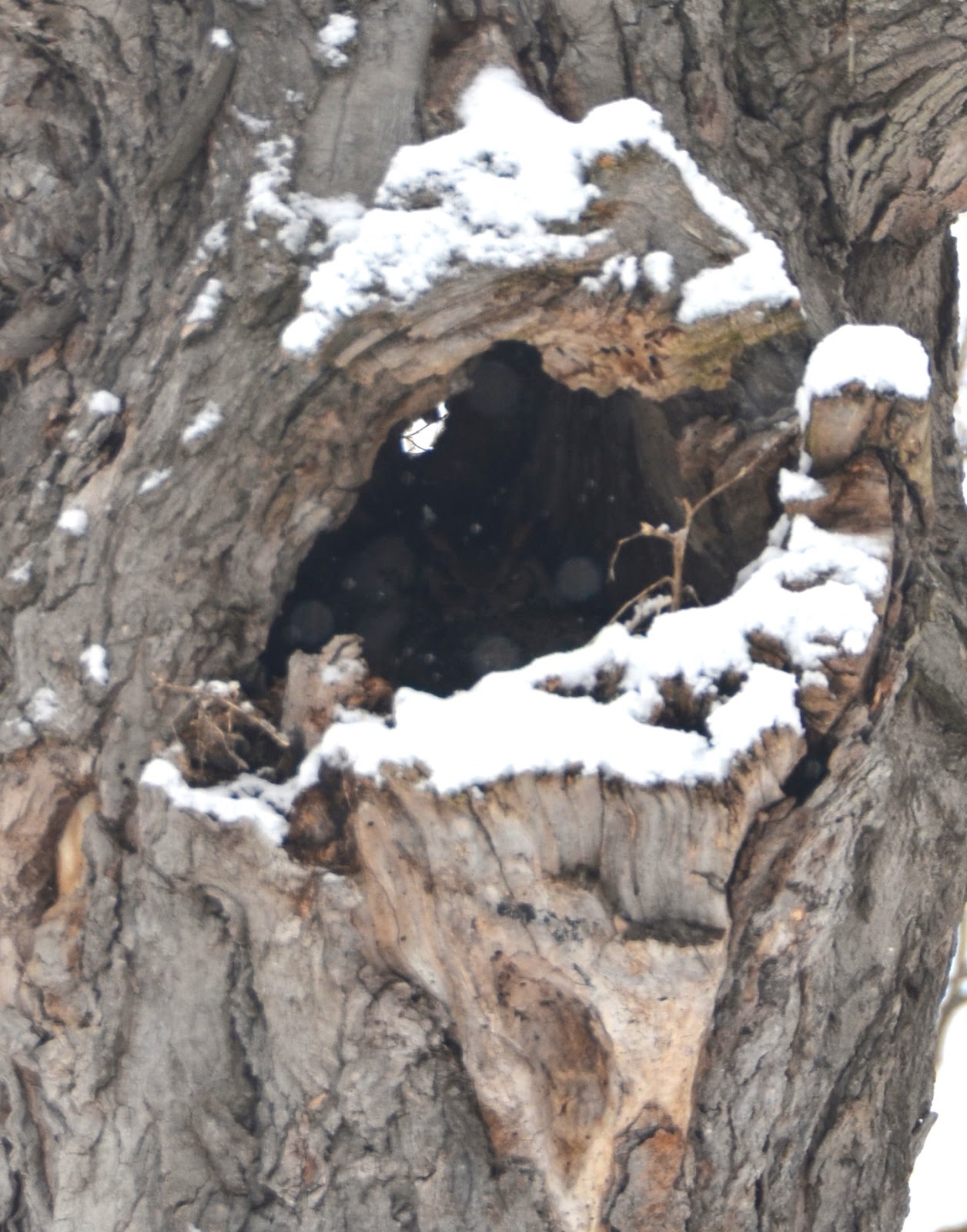
Then nearby there was a large cavity in a big tree that had the babies and presumably mama owl. They were pretty deep in the cavity and the pictures aren't fantastic but if you look closely you can see them. 
Great-horned Owl nest
 I was quite amazed at the balls on one of the local Canada Goose. It actually tried to fly up and scare the owls from their nest. Needless to say the owl inside definitely had a problem with that! The goose got banged up but not killed and it definitely left the area pretty quickly.

A few weeks later I went back to see how the babies had grown with my friend Gwyn who had also never seen a Great-horened Owl. Ohh my had they grown. Both parents were out of the nest this time and the two babies were really visible with one of them quite bravely poking itself out. They had developed more of a pattern and distinctive feathers compared to their general white-grey fluff that they had before.
Great-horned Owl nest
I will never tire of owls and I can't wait for next April to go looking for more. They grow up fast and going back to check on them at various times was very interesting.