Showing posts with label American Kestrel. Show all posts

Tuesday, 10 February 2015

Ecuador- Part 1/3 Otavalo

It is often very difficult to find the time and motivation to work on things such as uploading pictures or writing blogs after a long trip since you always come back and are swamped with an inbox of 1000s of emails, work to catch up on and just the whole settling back into regular life after living a dream. This has definitely been the case since my trip to Ecuador so rather than split it up by day like I usually do I am cramming everything into three parts.

OTAVALO
After the flight landed in the brand new Quito airport we got a $60 taxi (more expensive than usual because we got in at the middle of the night)  to Otavalo and stayed at Riviera Sucre. The hostel was very nice with a garden of potted plants and very nice breakfasts.  We even had a black-tailed trainbearer (hummingbird with a really long tail) visiting the flowers as we eat. 

Spices for sale in Otavalo markets
The Otavalo market at Plaza de Ponchos is the big draw for tourists to visit the area which specializes in textiles. I bought two blankets made from synthetic alpaca. Most people will insist that their products are alpaca but they are not pure and are combined with other polyester type materials. If you pull a piece of hair off and burn it it should turn to ash if real and pure but will melt/ form globs if not real.
 
Textiles in Otavalo
 The real and traditional textiles for the most part are found in the towns outside of Otavalo and are just a quick taxi or bus ride away. Their blankets, ponchos etc are all dyed with natural sources (such as mushed up mealy bugs or plant roots) and don't have the bright colours that you see in most of the main markets. 

Textiles in Otavalo
 COTACACHI
Unfortunately a late start in the day meant we didn't get to Cotacachi Lake as early as we would have liked. This volcanic lake is set in paramo, a habitat that is high elevation, rocky with mostly low lying plants and few trees growing in the valleys between hills.  
Cotacachi Lake
 There is a trail that loops the lake and they say it takes 4 hours to walk it but if you are a biologist or plan on stopping at all to actually look at things plan on taking the full day. It has gorgeous views and amazing wildlife to see so it is worth spending the time. We barely made it 1/3 of the way!


Cotacachi Lake
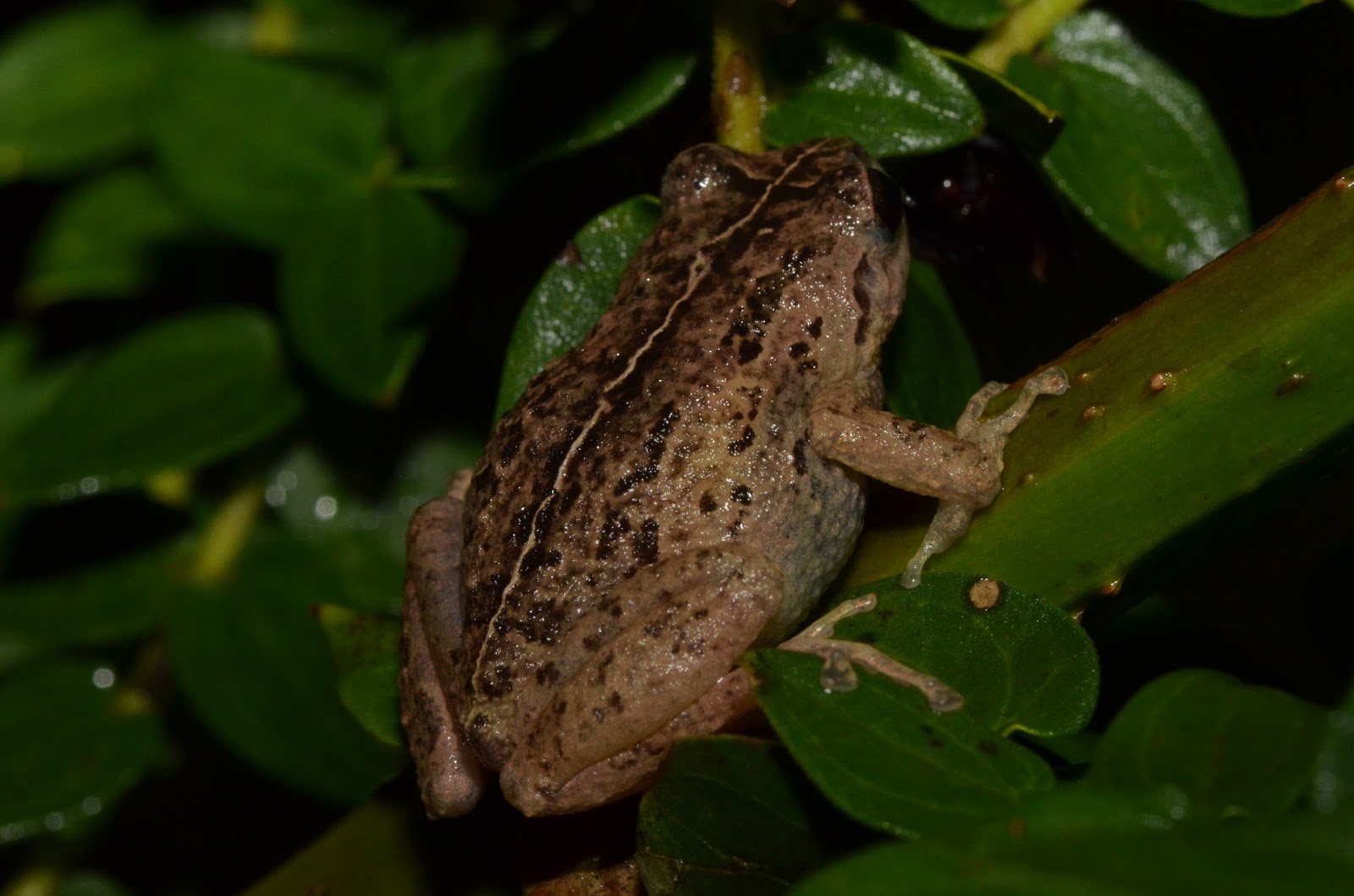
 At the beginning of our hike it was starting to rain and by rain I really mean pour down water like someone just dumped a bucket on your head and continued that for about 30 minutes. Amidst the rain I could hear at least two species of frogs calling back and forth but the rain made it impossible to locate a single one and when it stopped so did they.

Cotacachi Lake
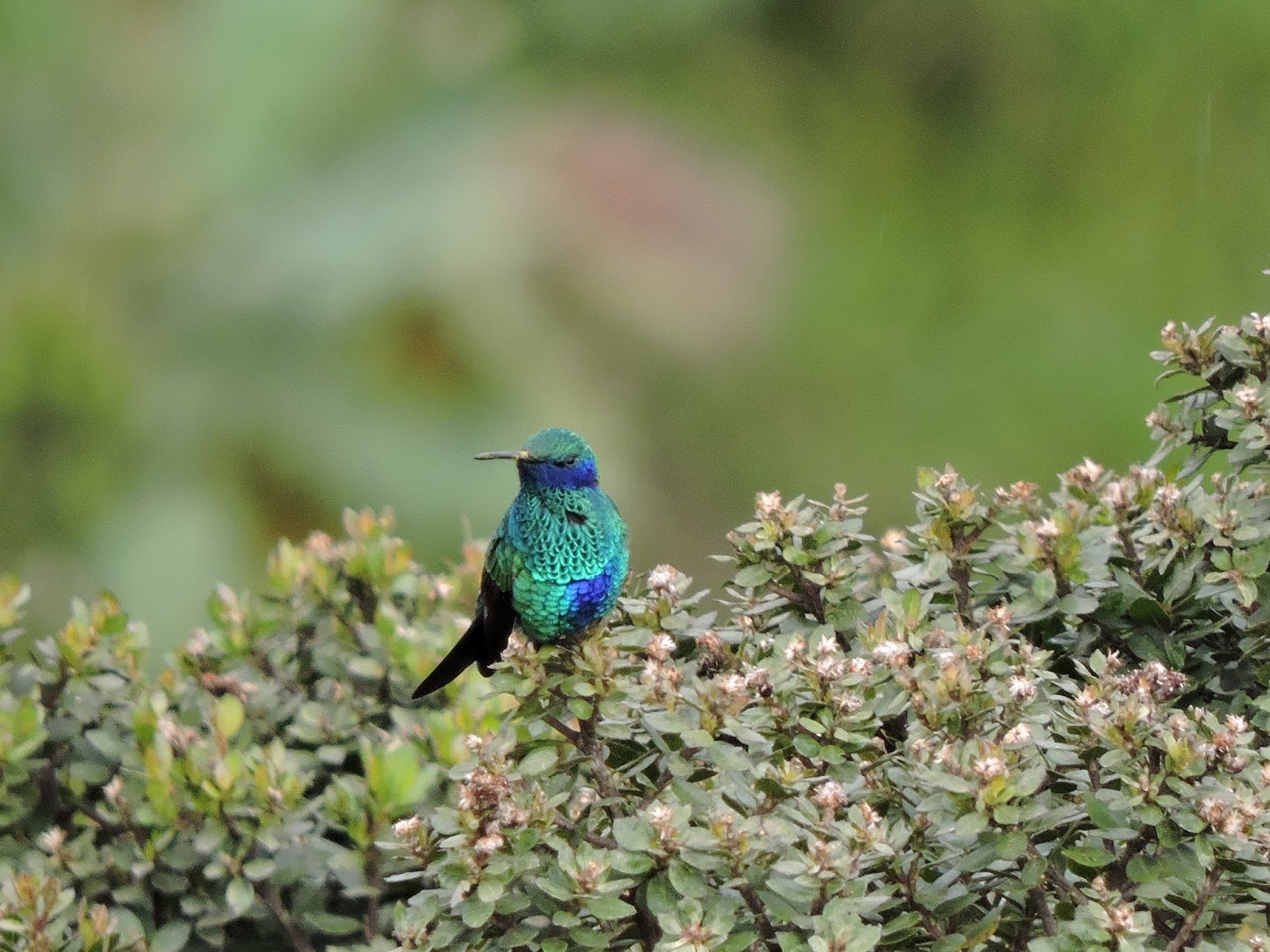
 The birds and reptiles came out when the rain stopped and those were much easier to find. My favorites were the scarlet-bellied mountain tanagers, black-chested buzzard eagle and sparkling violetear.


Scarlet-bellied Mountain Tanager
Sparkling Violetear
The trail loops around the top of the mountains and some birds are harder to see since they are down in the shrubs and trees hidden in the valleys. The best way to see birds is to just sit in one of those spots and watch for a while.

Another View of Guinea Pig Lake
 As soon as the sun was out the reptiles came out and were scrambling around in everything that had thorns. Good protection from birds or anything else grabbing them but it did make it difficult to get a good look. One species was a skink but I have no good pictures and this was the best  could get of the lizard.

Lizard at Cotacachi
 The plant life was definitely one of the most interesting things. The diversity of orchids alone was amazing and they covered more space than I have ever seen before. It sometimes looked like there were fields of them mixed in with bromeliads growing on the ground, ferns, Lycopodium sp., Equisetum sp. and few other wildflowers.
Masdevallia sp.
CASCADA DE PEGUCHE
The "Septembre 8" bus took us to the town of Peguche where you can find some good quality textiles but we continued on to the waterfall down the road.

Female Blue and Yellow Tanager
We went down a trail behind the washrooms in order to avoid the crowds of kids going up to the waterfall. It was definitely a mistake to visit this area on a holiday. But it gave us a chance to see some birds in a quite area before walking up to the falls. The river below the falls had canals running into town that collected water. The grass is low lying and seams almost groomed but shrubs and trees surround the valley sides.


Rufous- chested Tanager
 The waterfall was spectacular. Lush green everywhere and mist rolling off the falls towards the rocky areas beneath. Yet again the downside was the hoards of children spraying foam and throwing chalk at each other since that is what they do on holidays. I really hope it all got cleaned up since the mess was disgusting.


Again this trip, I come to be reminded that sometimes just listening to and watching nature has immense rewards and you see things you never expected. I was watching a male kestrel land on a branch with his meal and I expected him to start eating it but instead he started calling. The female came down and grabbed the gift and took it up to her nest.


Later at night the falls had very different wildlife. The areas was quite except for calling frogs. These represent the two different varieties I could find but potentially could be the same species of rain frog since they have a lot of colour variation.


Friday, 13 April 2012

Toronto Green Living Show

Today I went to the Toronto Green Living Show. There were a lot of neat ideas related to conservation ranging from reusable heat pads to a children's card game that was similar to pokemon but with real animals.There was environmentally themed artwork posted in a campaign to stop the Mega Quarry from being developed. A lot of this artwork was very well done and creative.

I initially was quite shocked at the amounts of plastic and waste being created by the free samples at various food vendors. Later I did notice that most of the plastic was recyclable and the spoons were often biodegradable. The most environmentally friendly sample I had was in a small jar that we drank juice from and gave back for them to reuse at other presentations. That little bit of effort that it's going to take to wash those probably saved more waste from going into the environment. Very interesting and good idea. Anyways enough of the environmental impacts and everything because I'd rather not turn this blog into a place for long winded rants.

A group that I am a part of called Wild Ontario is a volunteer organization that takes care of unreleasable injured or imprinted birds of prey and uses them for educational outreach. I attended the Green Living Show with this group and was giving presentations about the birds and talking to people for most of the day. I did however manage to get some time to grab some last photos of these amazing birds before I graduate and leave Guelph and sadly also Wild Ontario. So without further delay here are some amazing creatures:

American kestrels are part of the falcon family. Related to the peregrine falcon they are fast fliers with streamlined bodies.  They have many adaptations to being predators of other birds. Their streamlined body and strong angled wings allow them to catch other birds in the air while diving at great speed. They catch the birds with their sharp talons and can kill them quickly with a tomial tooth. However, kestrels aren't restricted to only eating birds. These agile fliers can catch insects such as dragonflies and small mammals.
Lianne and Apollo (Male American Kestrel)
 American kestrels in these photos might appear quite small but they are in fact fully grown. Most birds do all of their growing within their first summer. They are a migratory species and will need to be fully grown and flying by the time they leave the nest.
The most colourful bird of prey
   The first bird I ever got trained on at Wild Ontario was Artemis. Artemis is a female American Kestrel. You can tell the difference between male and female kestrels because they are sexually dimorphic (males and females look different) in terms of colour. The males are brighter coloured.  Artemis was taken out of the wild illegally. This was reported and she was handed over to Wild Ontario after she was deemed unreleasable by a rehabilitation center in Toronto. When we first got her she had no flight feathers or tail feathers. This is likely because she was kept in a cage that was too small. She wasn't able to fly at all but over time grew her feathers back. Unfortunately she was still too comfortable with humans to return to the wild.
Artemis (Female American Kestrel) and I
Helen-Marie is a new member of Wild Ontario and after months of training she is now holding her first bird. Congrats and welcome!
Helen-Marie with Apollo, Kerry with Einstein

Helen-Marie, Apollo and Jenn

Socrates is the founding father of Wild Ontario. In 1987, Socrates was one of the many avian patients treated by the veterinarians at the Ontario Veterinary College’s Wild Bird Clinic.  Socrates had been hit by a car, and had severely broken his left wing. A new type of surgery was performed on Soc in an attempt to fix his broken wing. This involved filling the bone with a substance that would dissolve over time while allowing it to heal over top and eventually leaving the bones hollow. Unfortunately for Soc this procedure was new and wasn't successful on him. However it has been greatly improved and has been successful on other individuals. Since Socrates was injured badly and could not fend for himself in the wild he became part of an education program which expanded after the wild bird clinic closed and is now known as Wild Ontario. 
Jenn and Socrates (Male Turkey Vulture)
 
 Einstein is an imprinted bird. Unlike Socrates who is physically injured Einsteins mind is the reason why she is unreleasable.  After a tree fell down it was reported that there had been an owls nest inside of it. The eggs got taken to a rehab center and were taken care of until they hatched. Owls lay their eggs a day apart and they usually hatch a day apart as well. Einstein hatched first and the vets weren't ready for her so the first thing she saw was a bearded man. This owl now thinks she is a bearded man!  Einstein can't go back to the wild because she wouldn't recognize her own species and could kill other owls or hurt people by trying to get food from them. Einsteins story isn't all bad though. Her two younger siblings didn't imprint on anyone and they did get released back into the wild.
Kerry and Einstein
Birds can't sweat so they will pant like dogs when warm
Einstein is actually named quite ironicly because most of her head is filled with large cone shaped eyes rather than brain
 

Helen-Marie and Kyle with Einstein


Whistler is a female Broad-winged Hawk. She was also taken out of the wild illegally. Whis didn't loose the ability to fly in captivity  but she did get frostbite. As a migratory species she can't cope well with Canadian winters and the person who had her in captivity did not deal with this issue as well as they could which resulted in Whistler loosing a few talons on her feet.
Lianne and Whistler (Female Broad-Winged Hawk)


 Whis is quite well named and Broad-winged hawks have a very loud whistling screech.


All of the birds seen above are wild animals that have been deprived of their natural life. Bird of prey are high maintenance, dangerous and do not make good pets. It is illegal to keep a bird of prey without a falconers license.  The people in these pictures have been trained to work with these birds.  Please keep these birds in the wild where we and future generations can admire them.

For more information about Wild Ontario see the website: http://www.ourwildontario.ca/index.html