Showing posts with label Museum. Show all posts

Wednesday, 17 October 2018

Togakushi, Nagano, Japan

In the mountainous area of Northern Nagano sit the five shrines of Togakushi spread out around the base of Mt. Togakushi. The area is a mix of history, religion and nature with trails winding through rows of 400-year old cedar trees and along streams and bridges. The five Shinto Buddhist shrines around the base of Mt. Togakushi are each dedicated to different gods and although I was hoping for a nice walk through nature the shrines are linked by roads.

If you walk up the road from the bus stop the first shrine you reach is the Togakushi Shrine Hinomikosha (戸隠神社火之御子社) but if you go down the road  you can get to the Lower Togakushi Shrine (戸隠神社宝光社).  We mistakenly walked up first and didn't see the lower shrine until after dark on our way down the mountain.
 Togakushi Shrine Hinomikosha 戸隠神社火之御子社
The town looks like a ski village combined with old Japanese temples. It is a very odd mix since a lot of the houses in the town don't have the same architecture as traditional Japanese houses and look more like American chalets.
Togakushi
Togakushi
The Togakushi Shrine Chusha (戸隠神社中社)  is in the middle of the town and is one of the largest shrines out of the five Togakushi Shrines.
Togakushi Shrine Chusha (戸隠神社中社)
There are many other small temples and shrines in the down other than the original five shrines. The walk along the small roads are colourful with fall leaves and the views of the mountains around are quite spectacular.
Togakushi
Togakushi
Togakushi
Togakushi
The Togakushi Folk Museum / Ninja House (戸隠民俗館) is one of the main attractions of the area besides the ski hills and shrines. The museum is set up with a series of buildings that make it look like a small village. Buildings have various themes of history. The first was cultural artifacts including clothing, farm equipment and tools used for work.

 Togakushi Folk Museum / Ninja House (戸隠民俗館)
 Togakushi Folk Museum / Ninja House (戸隠民俗館)
 Togakushi Folk Museum / Ninja House (戸隠民俗館)
Another building displays lifestyle and is set up as a house with antique furniture and relics as well as pottery, cabinets, etc. it had scrolls, books and other tools used in the house.
 Togakushi Folk Museum / Ninja House (戸隠民俗館)
The top floor of that building is themed as the history of the ninja school and shows equipment and tools used by ninjas including swords, grappling hooks, shuriken and swords.
 Togakushi Folk Museum / Ninja House (戸隠民俗館)

 Togakushi Folk Museum / Ninja House (戸隠民俗館)
 Togakushi Folk Museum / Ninja House (戸隠民俗館)
 Togakushi Folk Museum / Ninja House (戸隠民俗館)
 Togakushi Folk Museum / Ninja House (戸隠民俗館)
 Togakushi Folk Museum / Ninja House (戸隠民俗館)
 Togakushi Folk Museum / Ninja House (戸隠民俗館)
My favorite building was the ninja house, which was an escape room type house with secret doors and traps.  We took our time going through and enjoyed discovering all of the secrets that the house had but apparently we still made it out quickly. They don't actually officially time you though like they do in an escape room.
 Togakushi Folk Museum / Ninja House (戸隠民俗館)
 Togakushi Folk Museum / Ninja House (戸隠民俗館)
 Togakushi Folk Museum / Ninja House (戸隠民俗館)
 You can practice throwing shuriken, ninja throwing stars, at a small structure for a few hundred yen.  You win a small ninja fan if you hit 5/7 or more.
 Togakushi Folk Museum / Ninja House (戸隠民俗館)
 The Botanical Garden (戸隠森林植物園) across from the ninja museum has lovely walking trails that wind through the forest. The forest is old and the expansive number of trails make it easy to get a bit turned around but there are maps fairly often.
Botanical Garden (戸隠森林植物園)
 The wetland areas have boardwalks that are alive with bird calls. There are many creeks and ponds that wind through the forest and the trails include areas of upland and lowland.
Botanical Garden (戸隠森林植物園)
The  Togakushi area of Nagano is famous for it's unique buckwheat soba and in front of the upper and fifth shrine there is a lovely small soba restuarant with a friendly staff. Back Yashiromae Naosuke (奥社前なおすけ) has really great soba and oddly enough they even sell buckwheat ice cream that is surprisingly good. 

The Togakushi Shrine deepest-placed shrine (戸隠神社奥社 大鳥居) is marked by a big stone torii gate and the path going up through deciduous forest to a large red gate.
Togakushi Shrine deepest-placed shrine (戸隠神社奥社 大鳥居)
Togakushi, Nagano, Japan
The path is bordered by rows of huge 400 year old cedar trees that tower above you. Some of them could take about three or four people to wrap their arms around the trunk. The forest surrounding the row of cedars is mixedwood deciduous forest alive with fall colours. Being less alpine than the Kamikochi area there was more red and bright orange-yellow leaves.
Togakushi, Nagano, Japan
  The Upper Togakushi Shrine (戸隠神社奥社)to the sun goddess is the highest placed of all of the five shrines. It is not the largest or the most decorated but it sits on the mountain with a lovley view of the fall colours surrounding it. 
 Upper Togakushi Shrine (戸隠神社奥社)
 Upper Togakushi Shrine (戸隠神社奥社)
 Upper Togakushi Shrine (戸隠神社奥社)
From the upper shrine we walked one of the nature trails towards  Kagamiike (鏡池). The trail goes through the forest and is a lovely walk that can easily be done within a day in combination with walking the shrine route up. 
Togakushi, Nagano, Japan

Togakushi, Nagano, Japan
Kagamiike (鏡池) is a man made lake created by a dam. It has a nice view of the mountains surrounding it and on the day I visited the clouds were rolling over the mountains like a scene of a amine movie.
 Kagamiike (鏡池)

Sunday, 22 July 2018

Osaka (大阪市), Japan

Shitennoji (四天王寺) is a large temple with a big decorated pagoda and a Buddhist temple. It has a large pond with an incredible number of turtles in it. The temple grounds are fairly stark and empty with the majority of area being open bare dirt. 
四天王寺 本坊
Shitennoji (四天王寺)
Shitennoji (四天王寺)
Shitennoji (四天王寺)
 The park adjacent to the zoo (Kyu-Kurodahan Kurayashiki Nagayamon and 茶臼山古墳) has a few nice trails around it and views of the city buildings from inside the forest. A large pond with fountains sits in the center of the park  with bridges to connect between trails. Although the natural area is small it is home to a fair number of birds with an abundance of crows and herons. 
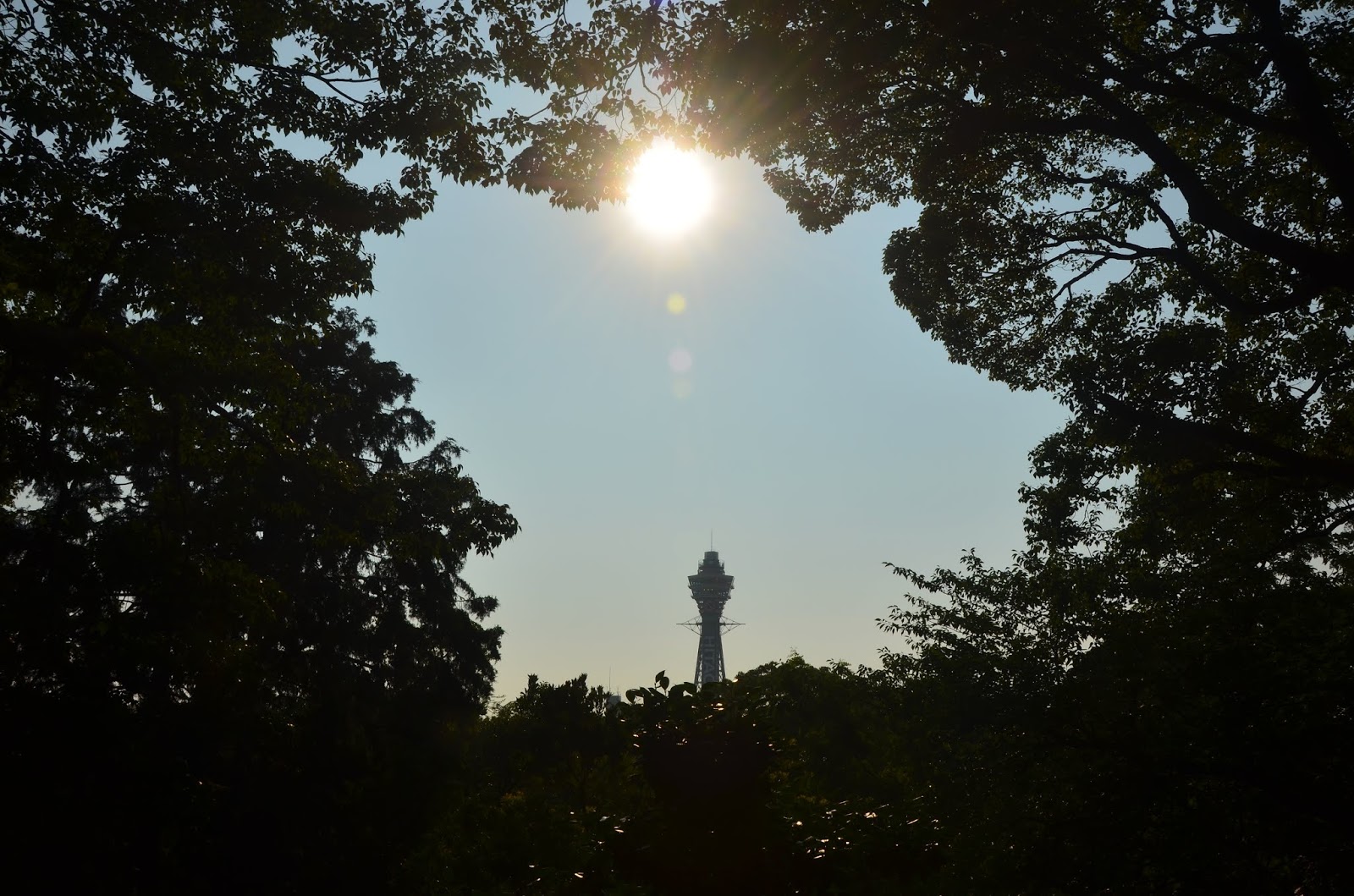
View of Tsutenkaku Tower from Kyu-Kurodahan Kurayashiki Nagayamon, Osaka
Kyu-Kurodahan Kurayashiki Nagayamon, Osaka
The gates of Isshinji temple (一心寺) are of incredibly modern design but the inside has traditional buildings and contains the remains of many Osaka families. Most famously there is a Buddha statue created from powdered bones. Isshinji was running out of space to store the amount of ashes brought to the temple and came up with a modern version of Okutsu Butsu.They combined the ash with a type of resin and the resulting mixture was cast as a statue of Amida. Seven statues are completed with each statue using the ashes of about 150,000 people, so with the ashes of more than a million ancestors making up the statues it is not surprising that so many people visit the temple nowadays.
 Isshinji temple (一心寺)
 The area around Tenoji Station has many shrines and temples.
Pagoda in the Tenoji area

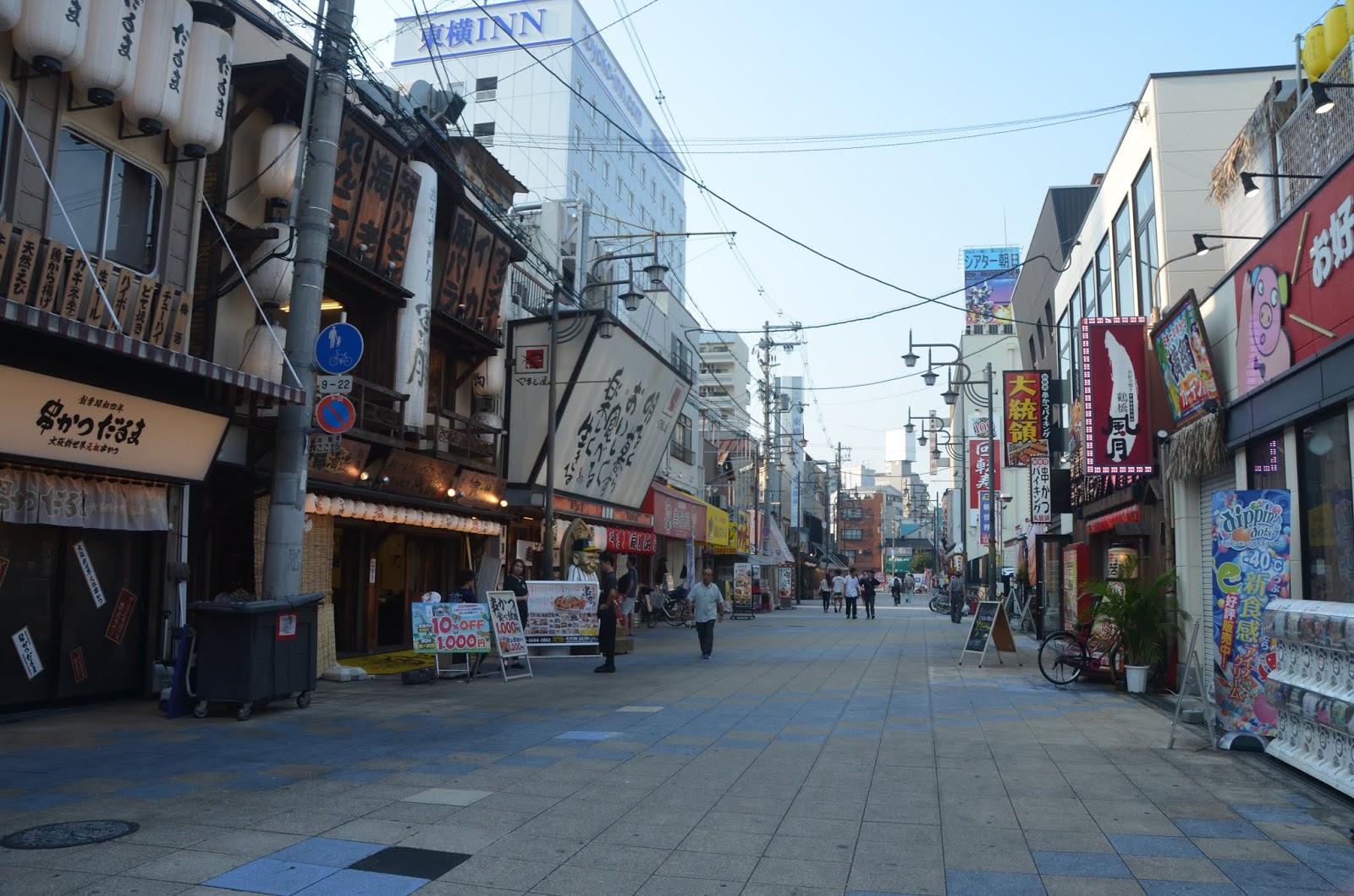
Shinsekai (新世界本通商店街)  with a small shrine contrasting against the buildings and Tsutenkaku Tower. Shinsekai was an older district near the slum area that was abandoned after the war and revitalized in the industrial exposition, which led it to become a tourist attraction. 
Shinsekai (新世界本通商店街)

Shinsekai (新世界本通商店街)
Now Shinsekai is full of restaurants and bars with embellished lights and decorations. There are signs everywhere and  at night the area is light up with a craze of colours. Although the area is quite lively it doesn't feel crowded.
Shinsekai (新世界本通商店街)
Shinsekai (新世界本通商店街) at night
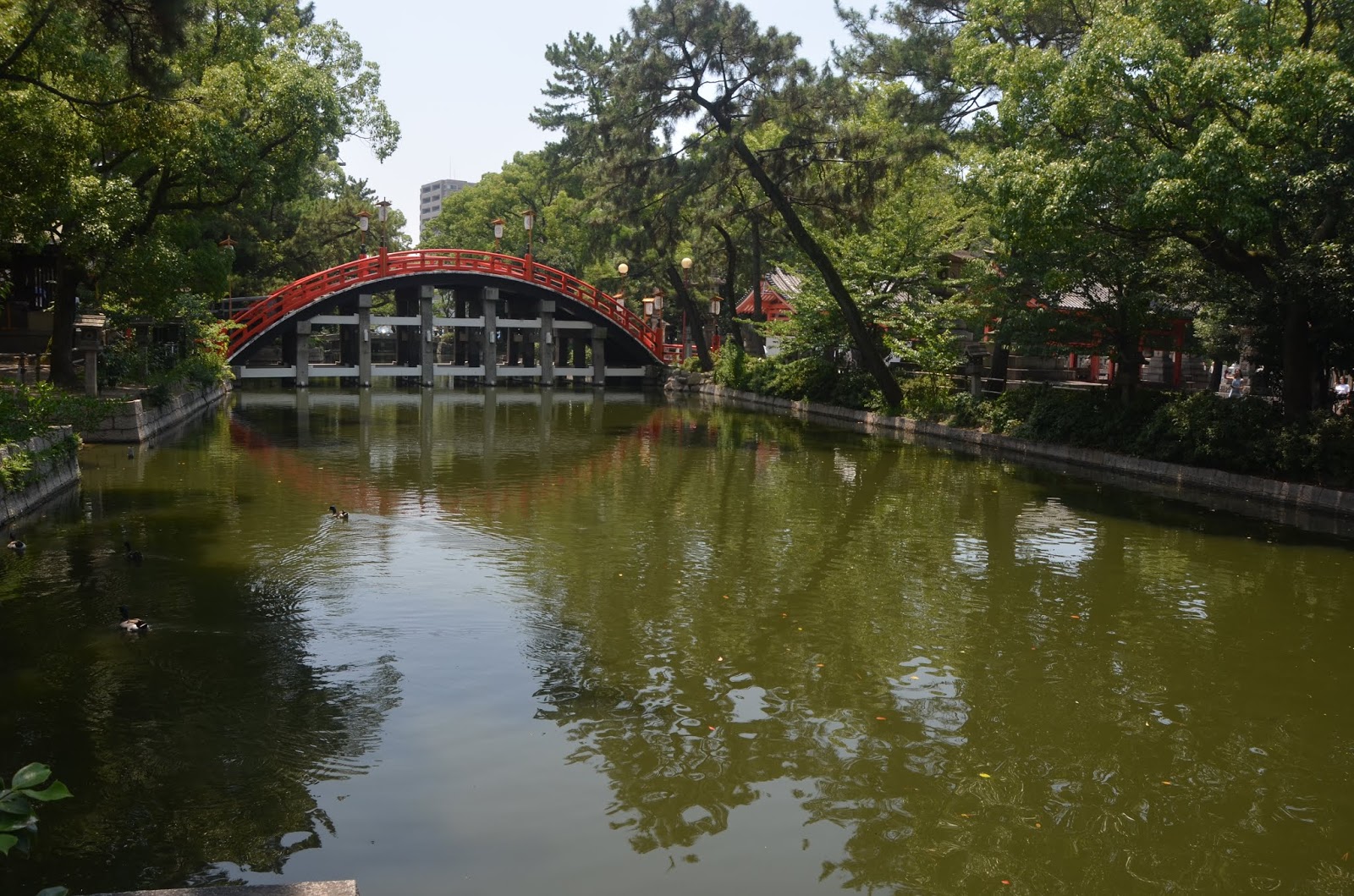
Sumiyoshi Taisha (摂津国一宮 住吉大社) is a lovely temple with a pond and idyllic bridge. The temple grounds are a lot nicer than Shitennoji with trees and arches everywhere and a lot of small shrines. The decorations for summer festivals were starting to be set up so it was decorated with lanterns and flags.
Sumiyoshi Taisha (摂津国一宮 住吉大社)
 Foxes are regarded as messengers for Inari a shinto spirit. There are many statues and images of foxes frequently with bibs around Japanese temples.
Sumiyoshi Taisha (摂津国一宮 住吉大社)
A Guzei, or Red Bridge, is a part of Japanese gardens and temples. Both the bridge itself and the red color of a Guzei have symbolism. Bridges stand for the crossing from the physical world into the realm of the spirit, leaving behind profane and confused worldliness as we are cleansed into a state of purity, wisdom and sacred nature. The color also represents the sacred, as well as wisdom and transformation. It is entwined with Zen concepts of preserving the life force, rejecting the delusion of attachment to physical things and attaining true discernment. Thus these Red Bridges deliver a double dose of positive growth and spiritual change. They are often described as representing the path to salvation.
Sumiyoshi Taisha (摂津国一宮 住吉大社)
The park near Sumiyoshitaisha Station (住吉大社駅) actually had a fair number of birds even for a fairly open city park. There were herons, egrets, starlings and sparrows around the many ponds and small streams.
park near Sumiyoshitaisha Station (住吉大社駅)
Gray Heron
Little Heron
Little Heron
It was a lovely spot to relax in the shade by the water and have a convenience store lunch. There also appeared to be a pokemon go spot in the middle of the park where many people on bikes were standing on their phones.
park near Sumiyoshitaisha Station (住吉大社駅)
Osaka Castle (大阪城) and the surrounding park was almost deafening with cicadas. The castle is surrounded by two sets of large moats with a large main gate. From the gate you can just see the castle.
Osaka Castle (大阪城)
Osaka Castle (大阪城)
The Hōkoku Shrine (豊國神社) is a fairly large shrine just outside of the castle. 
Hōkoku Shrine (豊國神社)
Osaka Castle is quite decorated with gorgeous green,black and gold. The small pond at the top floor is one of the few quiet places you can get a photo without other people in it.
Osaka Castle (大阪城)
Osaka Castle (大阪城)
Osaka Castle (大阪城)
The view from the castle shows the contrast between the park and city behind it. The museum is very modern on the inside and you can walk up a lot faster than if you wait to take the elevator.
View from Osaka Castle (大阪城)
The view from the other side of the canal gives a lovely landscape of the bridges and the tour boats going in front of the castle.
Osaka Castle (大阪城)
Osaka Castle (大阪城)
 Kita is a fairly large district with bars, and an arcade/shopping district. Small izakayas can be found on many of the side streets to the large covered shopping street. The food is very good and prices are a bit cheaper than in Shinsekai, but that might just be the place we went to. Streets were lively but not crowded and it was much less touristy, without any gaudy decorations (giant crabs and puffer fish, etc).
 Kita,Osaka

 Kita,Osaka

 Kita,Osaka
Minoo Park (箕面公園) is accessible from Osaka via public transit. It has a decent number of trails and you can do a nice loop of the park. It makes a lovely day trip if you want a bit of a break from the city. On a hot day the shady trails are quite a relief.
Minoo Park (箕面公園) Map
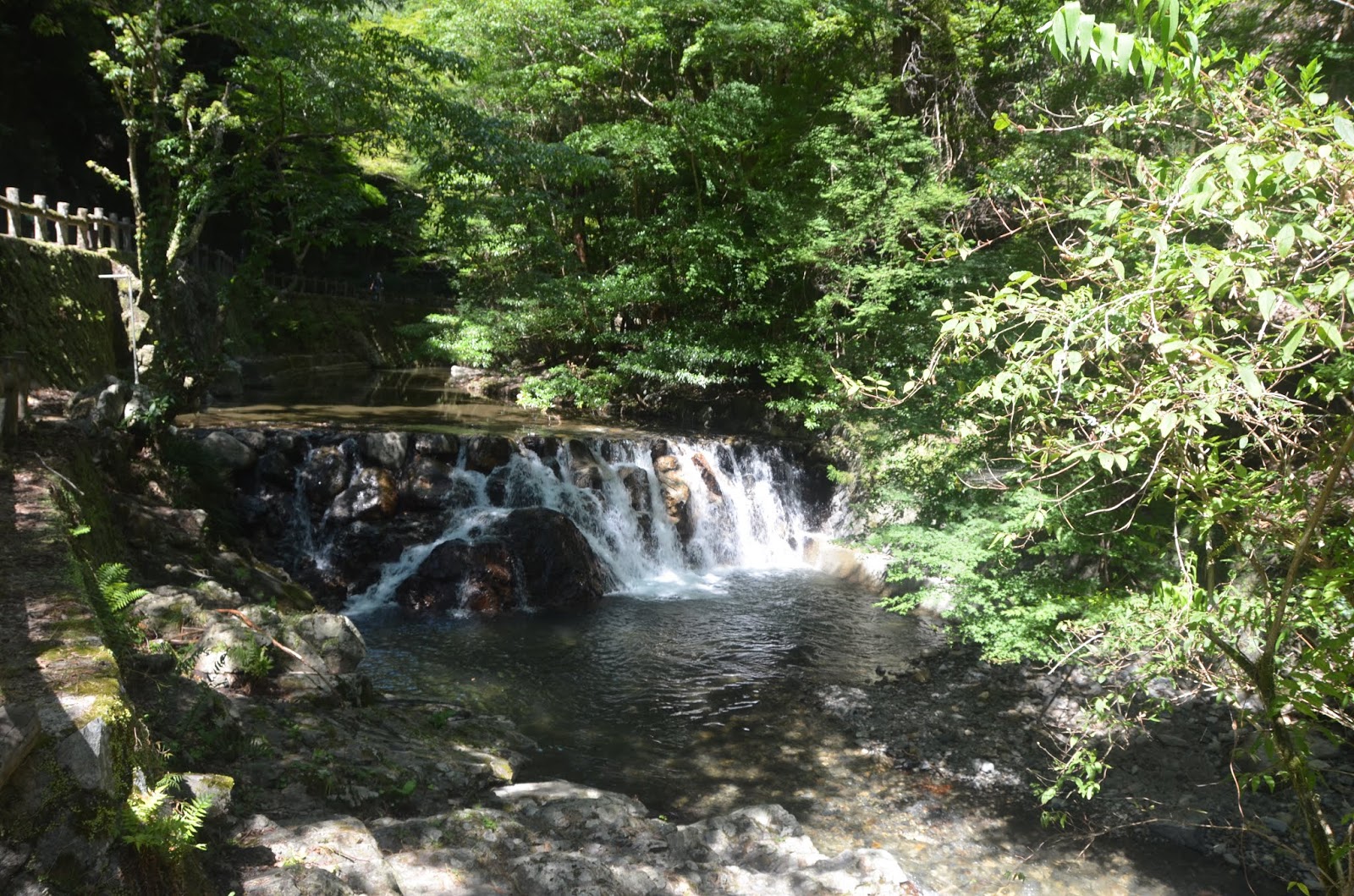
 The walk along the river is very lush and green with small falls in various places. A lot of the trees are Japanese Maple so int he fall this park would be very stunning in fall colours.
Minoo Park (箕面公園)
Minoo Park (箕面公園)
The waterfall is quite busy and many tourists drive up to a spot higher and hike a shorter distance than actually walking all the way through Minoo Park. There is a little area with shops just outside of the waterfall and you get souvenirs, food or have a nice cold beer on a patio looking over the waterfall. I very much enjoyed the chance to try deep fried maples leaves, which were sold in various shops in town and at the waterfall.
Minoo Park (箕面公園)
Minoo Park (箕面公園)
Deep fried Japanese Maple leaf
 The waterfall is  not very large but it is very pretty.
Minoo Park (箕面公園) - Minoo Waterfall
There are two viewing platforms in the park. We only visited one and it had a bit of a view of the city but the other was on a detour trail uphill and it would probably have a much nicer view of the city.
Minoo Park (箕面公園)
 A temple is just on the side of the road in Minoo Park so it is very easily accessible to visit. It is a smaller temple than many of the Osaka city temples and is not heavily decorated but I like its simplicity.

Minoo Park (箕面公園)
Namba was the most crowded I have ever felt in Japan. The streets were packed at all times of the evening-night.
Namba, Osaka
Namba, Osaka
Namba, Osaka
Within the Namba area, the Dotonbori- Osaka night market (道頓堀) is a more original Japanese style street compared to the bustling shopping area and it's nearby flamboyant restaurants. We found a lovely little ramen shop for dinner here. 
Dotonbori- Osaka night market (道頓堀)
Hozenji (法善寺) is a small temple within Namba that has a Buddha statue covered in moss. Visiting at night you can't get a good photo of the statue but it was very cool to see. It really is covered completely in moss and everyone throws water on it after they pray. 
Hozenji (法善寺)
Keitakuen Garden (慶沢園) is a small garden near Tenoji Station. It has a central pond with a trail going around the pond. It costs a small amount to enter. We had our breakfast in the shade on a bench.These photos are in order going around the pond so hopefully they showcase the view somewhat close to as it was meant to be seen.
Keitakuen Garden (慶沢園)

 The view from the tower near Tenoji Station at the entrance to the museum (without paying or waiting for the top floor lookout) was okay but they had put up glass walls to block the wind and it makes standing up there very very hot!  I do wish we had thought of visiting the tower at night since it would have been quite the site with all the city lights.
Osaka
 Denden Town is said to be the must visit area of Osaka if you like anime. I was expecting a large area with themed shops, cafes, bars etc. but really it was just a small section of a street with many anime related stores selling figurines. I was hoping for stores that sold anime themed products and mostly cosplay stuff but there were very few of those and they had very limited selection. Animate was the largest store for anime fandom and had a lot of little things -phone cases, keychains etc.
 Denden Town, Osaka