Monday, 16 February 2015

Ecuador- Part 2/3 The Amazon

I must admit I have always been fond of barren habitats where unique species thrive under low competition and high disturbance but the tropics have always fascinated me and I can't help loving them just as much. I have seen other tropical regions of Central America but the Amazon rainforest is definitely unique. The fast flowing river frequently flooding areas, ponds and wetlands so dark and full of tannins you look brown in the water, trees as tall as high buildings and animals so bright they look like jewels or so well camouflaged you had no clue they were even alive.
Lake at Sacha Lodge
SACHA LODGE

I stayed at Sacha Lodge which is located on a small pond/lake pretty far down the Rio Napo. The boat ride is enjoyable and you get a good look at the various industries along the river including sparse towns and predominantly mining stations.Sacha Lodge is very well kept and when I was there it was under construction to make it even better. The food is wonderful and the people are really friendly.
Sacha Lodge

Cabins at Sacha Lodge
The rainforest seamed to come even more alive at night after the intense rain we get during the day. I saw two tri-coloured swamp snakes right off the boardwalk. There were a constant chorus of frogs and toads calling as soon as it got dark. This was of course much louder after rain. Oddly enough it didn't rain at night but did almost every day. I must admit that my identification of these animals is based on a very incomplete field guide to the common reptiles and amphibians of the Amazon.
Sharp-nosed Toad (Bufo dapsilis)
The frogs and toads were fantastic but the most interesting find for me was definitely the second night when my amazing native guide and now friend (Shan-shu) found a climbing salamander! I had never expected to see any salamanders in the amazon since I was under the impression they are quite unusual and hard to find.
Amazon Climbing Salamander (Bolitoglossa altamazonica)
 The species of frog calling did differ based on time of day and between location. The wetter areas by the docks had more toads and smaller frogs calling but up near the butterfly garden had larger arboreal species.
Map Treefrog (Hyla geographica)
 Other than treefrogs, my favorite group of frogs is the poison dart frogs. Their small size, bright colours and very interesting behaviors all fascinate me. Shan-shu is again credited for finding my favorite frog that I have seen in the amazon since this little guy could fit on a quarter (with room to spare).
Sanguine Poison Frog (Epipedobates zaparo)
 On a walk down the boardwalk one day I stopped in shock and awe and called for the guides to come back since they had walked on ahead looking for birds. The oddest amphibian I have ever seen was floating in shallow water like a leaf. This was MY best find of the entire trip as it turns out and the guides were very impressed. The older guide who was born and raised in the area had only seen one suriname toad before and Shan-shu had never seen on in his life.
Utinga Suriname Toad (Pipa snethlageae)
The most common frogs in the area were crested forest toads, many-striped treefrogs, common polkadot treefrogs, amazonian rain frogs, rocket frogs and rough skinned treefrogs. This is very likely to change based on season and these were easier to find since they were calling in Februrary.

Common Polkadot Treefrog (Hyla punctata punctata)
Pale-striped Amason Poision Frog (Epipedobates hahneli)
The reptiles were't out often due to the rain we had pretty much constantly during the days but the few hours of sunlight we got in a day they all came out for!
Yellow Spotted River Turtle (Podocnemis unifilis)

Northern Caiman Lizard (Dracaena guianensis)

I only found three species of snakes in the 6 days I spent in the Amazon at Sacha Lodge. If I had been fully focused on finding them and if the weather had been a bit sunnier I might have had better luck. But with the rain preventing any diurnal basking snakes from coming out I only found common blunt headed snakes, tricoloured swamp snakes, common cat-eyed snakes and a high woods coral snake.
High Wood Coral Sake (Erythrolamprus reginae)

Despite being very tired from waking up at 4am for birds I made myself go out looking for reptiles and amphibians every night. I was determined to use every oppertunity I could to find new things and wouldn't go to bed without one. I did quite well by myself despite not being confident enough on the trails to go very far without getting lost. It is quite difficult in the jungle at night since everything looks green and similar with very little to mark the way you went.
View from the dining area at sunset
Masked Crimson Tanager
The bird life was incredibly diverse and it was hard to keep up with everything we were seeing.  The best birding was at the lookouts. Sacha Lodge has two lookouts the first is a set of three towers linked by bridges. It goes up quite high (36m tall) and gets you above/equal to most of the trees.
Walking across the bridges between towers
Pied Puffbird

Female Blue Dacnis

Crested Owls

It was a lot easier to see birds from the lookouts because of the really dark lighting in the understory. Sacha has extensive trails to get to the lookouts and other interesting hotspots for birding. Even along the way the guides know exactly where to find roosting birds that would otherwise never be seen. These crested owls were my personal favorite from the trails.
Extensive trails at Sacha Lodge

The other lookout was by far my favorite though. Built into the tallest species of tree that grows in the amazon, the Kapora Tree, it was definitely over 40m tall. The climb was worth it though! The birds literally land in the lookout and you can see so far around you.
Cream-coloured Woodpecker
These are some examples of the birds that were in the tree with me. In addition to the ones pictured, many trogons, euphonias, flycatchers and a bare-necked fruit crow all landed in the tree while we were there.
Long-billed Woodcreeper

Golden-collared Toucanet

Plum-throated Cotinga

Yellow-browed Tody Flycatcher

At the top of the treehouse tower

Rufous-green Kingfisher

YASUNI NATIONAL PARK
The guides from Sacha can take you into Yasuni National Park for an aditional fee if you request it.  This is a good chance to see some really good parrot licks. The one on the river that everyone gets to see is shaky from the boat and only had 3 species of parrots. Mealy Parrots and dusky-headed parakeets were very common on the river salt lick. Blue-headed parrots were seen but did not come down to the lick.
Parrot Salt Lick

The one in the park had a really nice hide that you could sit in eat lunch and wait for the birds to show up. When they arrived it was deafening! The macaws come down to the ground first and the smaller parrots follow very loudly and cautiously. They almost looked like they were chasing each other off branches encouraging others to go ahead of them.
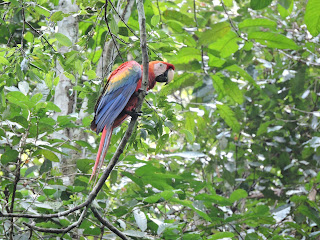
Scarlet Macaw
Yasuni is also quite good for manakins, trogons and anoles. I wish I could have had a chance to go there at night!

The sandbar island we visited on the way back had some very interesting birds that are unique to that habitat. They like the shrubby/tall forbs/wide leaved grassed that grow on sandy soils. This included chestnut-bellied seedeaters, grey-breasted crake, roseatte spoonbills and oriole blackbirds.
Chestnut-bellied Seedeater

Tuesday, 10 February 2015

Ecuador- Part 1/3 Otavalo

It is often very difficult to find the time and motivation to work on things such as uploading pictures or writing blogs after a long trip since you always come back and are swamped with an inbox of 1000s of emails, work to catch up on and just the whole settling back into regular life after living a dream. This has definitely been the case since my trip to Ecuador so rather than split it up by day like I usually do I am cramming everything into three parts.

OTAVALO
After the flight landed in the brand new Quito airport we got a $60 taxi (more expensive than usual because we got in at the middle of the night)  to Otavalo and stayed at Riviera Sucre. The hostel was very nice with a garden of potted plants and very nice breakfasts.  We even had a black-tailed trainbearer (hummingbird with a really long tail) visiting the flowers as we eat. 

Spices for sale in Otavalo markets
The Otavalo market at Plaza de Ponchos is the big draw for tourists to visit the area which specializes in textiles. I bought two blankets made from synthetic alpaca. Most people will insist that their products are alpaca but they are not pure and are combined with other polyester type materials. If you pull a piece of hair off and burn it it should turn to ash if real and pure but will melt/ form globs if not real.
 
Textiles in Otavalo
 The real and traditional textiles for the most part are found in the towns outside of Otavalo and are just a quick taxi or bus ride away. Their blankets, ponchos etc are all dyed with natural sources (such as mushed up mealy bugs or plant roots) and don't have the bright colours that you see in most of the main markets. 

Textiles in Otavalo
 COTACACHI
Unfortunately a late start in the day meant we didn't get to Cotacachi Lake as early as we would have liked. This volcanic lake is set in paramo, a habitat that is high elevation, rocky with mostly low lying plants and few trees growing in the valleys between hills.  
Cotacachi Lake
 There is a trail that loops the lake and they say it takes 4 hours to walk it but if you are a biologist or plan on stopping at all to actually look at things plan on taking the full day. It has gorgeous views and amazing wildlife to see so it is worth spending the time. We barely made it 1/3 of the way!


Cotacachi Lake
 At the beginning of our hike it was starting to rain and by rain I really mean pour down water like someone just dumped a bucket on your head and continued that for about 30 minutes. Amidst the rain I could hear at least two species of frogs calling back and forth but the rain made it impossible to locate a single one and when it stopped so did they.

Cotacachi Lake
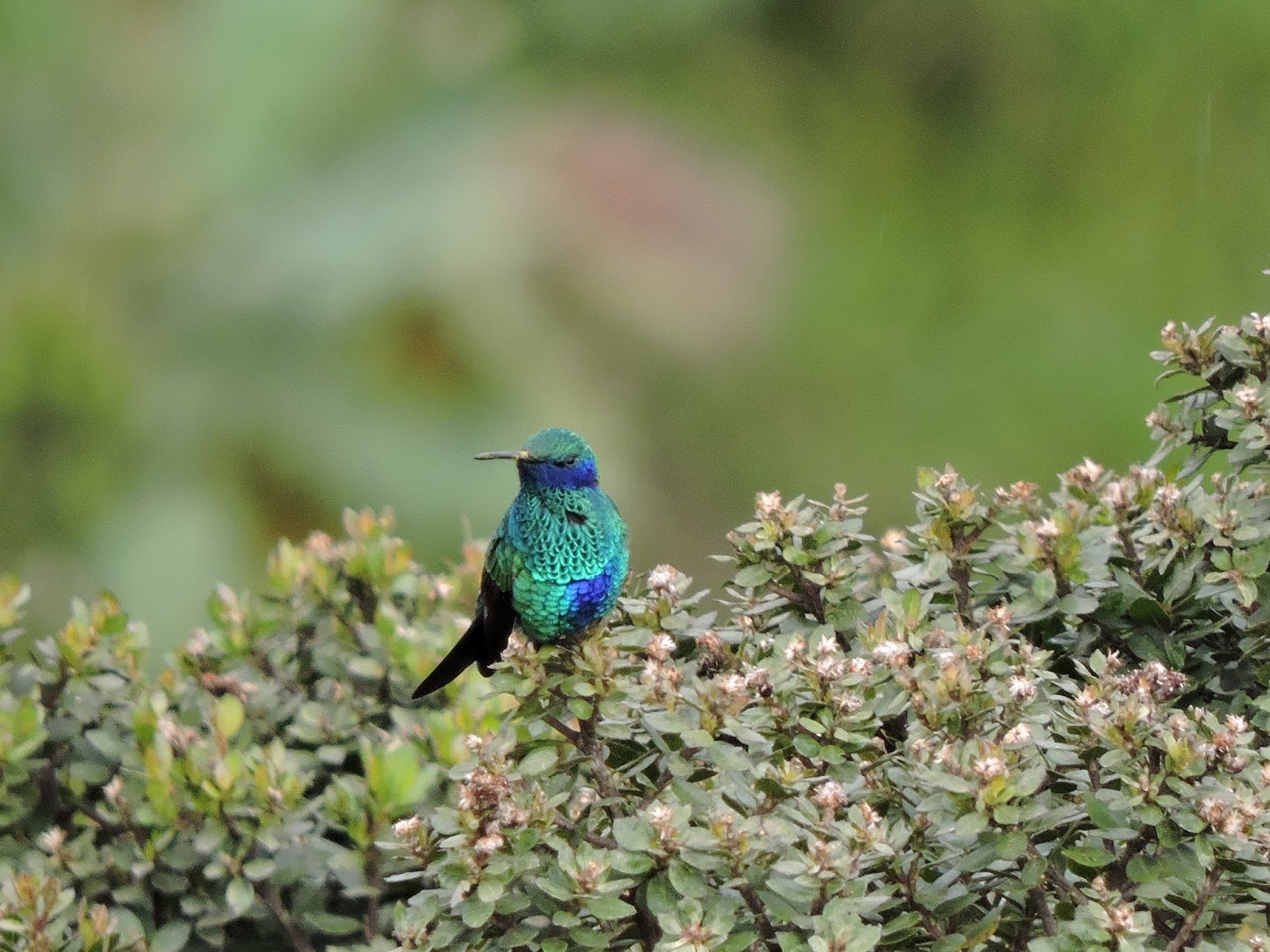
 The birds and reptiles came out when the rain stopped and those were much easier to find. My favorites were the scarlet-bellied mountain tanagers, black-chested buzzard eagle and sparkling violetear.


Scarlet-bellied Mountain Tanager
Sparkling Violetear
The trail loops around the top of the mountains and some birds are harder to see since they are down in the shrubs and trees hidden in the valleys. The best way to see birds is to just sit in one of those spots and watch for a while.

Another View of Guinea Pig Lake
 As soon as the sun was out the reptiles came out and were scrambling around in everything that had thorns. Good protection from birds or anything else grabbing them but it did make it difficult to get a good look. One species was a skink but I have no good pictures and this was the best  could get of the lizard.

Lizard at Cotacachi
 The plant life was definitely one of the most interesting things. The diversity of orchids alone was amazing and they covered more space than I have ever seen before. It sometimes looked like there were fields of them mixed in with bromeliads growing on the ground, ferns, Lycopodium sp., Equisetum sp. and few other wildflowers.
Masdevallia sp.
CASCADA DE PEGUCHE
The "Septembre 8" bus took us to the town of Peguche where you can find some good quality textiles but we continued on to the waterfall down the road.

Female Blue and Yellow Tanager
We went down a trail behind the washrooms in order to avoid the crowds of kids going up to the waterfall. It was definitely a mistake to visit this area on a holiday. But it gave us a chance to see some birds in a quite area before walking up to the falls. The river below the falls had canals running into town that collected water. The grass is low lying and seams almost groomed but shrubs and trees surround the valley sides.


Rufous- chested Tanager
 The waterfall was spectacular. Lush green everywhere and mist rolling off the falls towards the rocky areas beneath. Yet again the downside was the hoards of children spraying foam and throwing chalk at each other since that is what they do on holidays. I really hope it all got cleaned up since the mess was disgusting.


Again this trip, I come to be reminded that sometimes just listening to and watching nature has immense rewards and you see things you never expected. I was watching a male kestrel land on a branch with his meal and I expected him to start eating it but instead he started calling. The female came down and grabbed the gift and took it up to her nest.


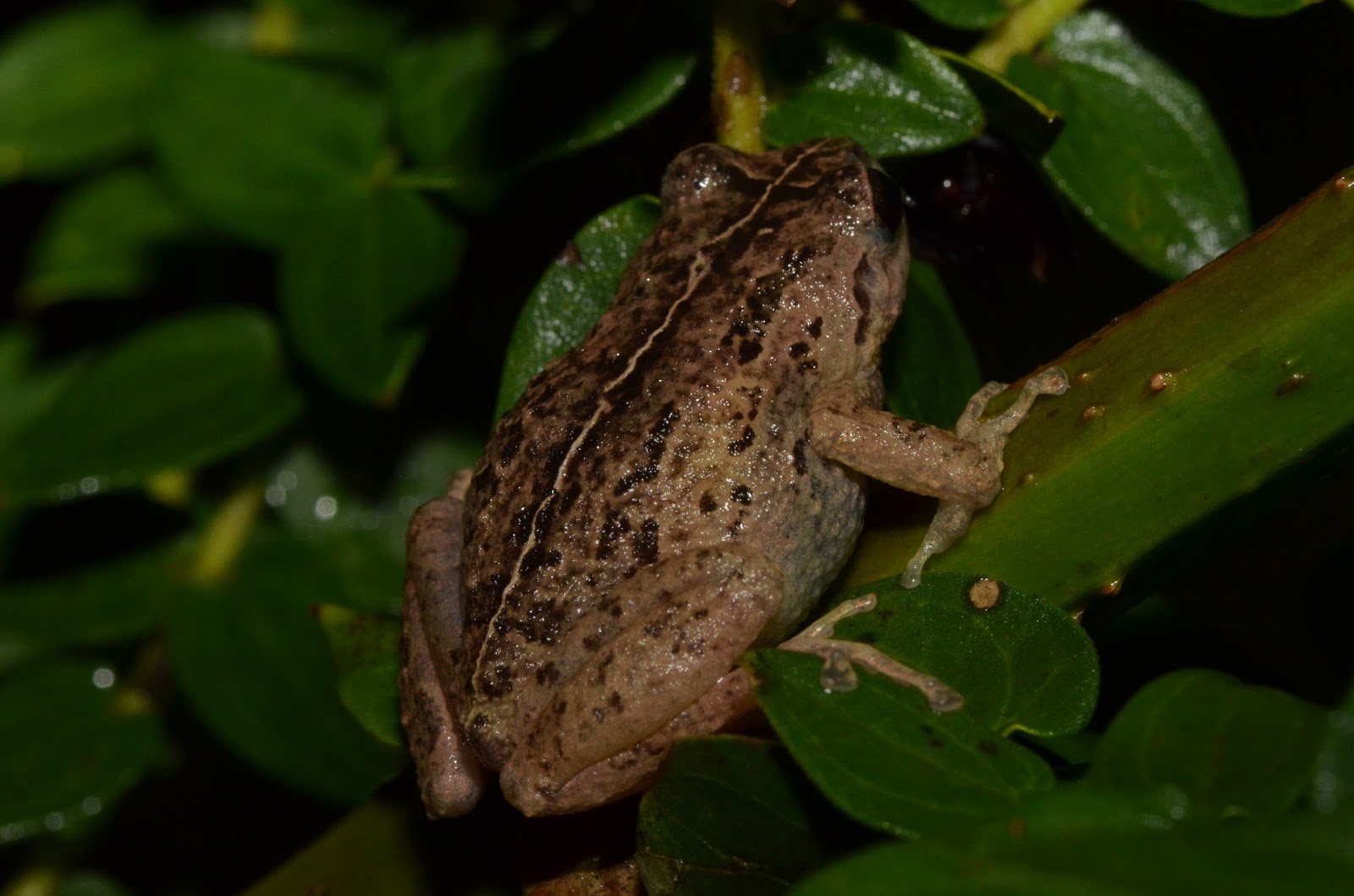
Later at night the falls had very different wildlife. The areas was quite except for calling frogs. These represent the two different varieties I could find but potentially could be the same species of rain frog since they have a lot of colour variation.


Monday, 5 January 2015

Introduction to Manitoba Alvars


Habitat shot of an alvar in Manitoba
Alvars are a globally rare ecosystems characterized by thin soil and sparse tree cover over limestone bedrocks. These were first discovered in Sweden by Carl Linnaeus and were given the name alvar for their barren appearance.  The openness of alvars is maintained by ecological processes such as erosion, flooding, fire, drought, frost heaving and grazing. These dynamic ecosystems are home to many rare and unusual species which are adapted to these disturbances. Alvars are under threats from garbage dumping, off-road vehicle use, mining, over-grazing, development and road building.
Recently, alvars were first discovered in the Interlake region of Manitoba and the Nature Conservancy of Canada and Manitoba conservation formed the Manitoba Alvar Initiative in order to study and preserve these unique ecosystems. 

Map of confirmed alvar areas in Manitoba (Manitoba Alvar Initiative, 2012)
Work done by the Manitoba Alvar Initiative (2012) represents only a “first approximation of alvar types” in Manitoba and the authors recommend that a “quantitative data-based classification scheme be developed to refine the conservation status of alvar types, establish site-condition metrics, recommend compatible land-management activities and advance conservation activities”. 

Table of the various alvar types and parameters used to define them
 My current Masters project aims to build on previous work by completing a comprehensive vegetation survey in order to form a quantitative classification scheme that will verify the alvar types (grassland, wet grassland, jack pine savannah, oak savannah, spruce savannah, boreal shrubland, prairie shrubland, intermediate shrubland) proposed by the Manitoba Alvar Initiative (2012). Additional goals of the project are to make preliminary observations on how disturbances, such as fire and grazing, affect the various alvar types. 

This season, species diversity, abundance and environmental data were collected for 103 plots (10mX10m) from June till August.  Locations of rare species, such as Gastonyi’s Cliffbrake (Pellaea gastonyi) which only occurs on exposed limestone ridges and tabletops, were recorded. The information collected from plots will be used to separate alvars into alvar types allowing for species lists and mapping to be completed for each of the 20 sites on crown land. The completion of this project will give us a better understanding of a complex, dynamic and unusual ecosystem so that we can properly manage and conserve its biodiversity. 

Cliffbrake growing on exposed limestone ridge